How to Play Tango Puzzle: Rules, Strategy & Solving Guide
What Is Tango?
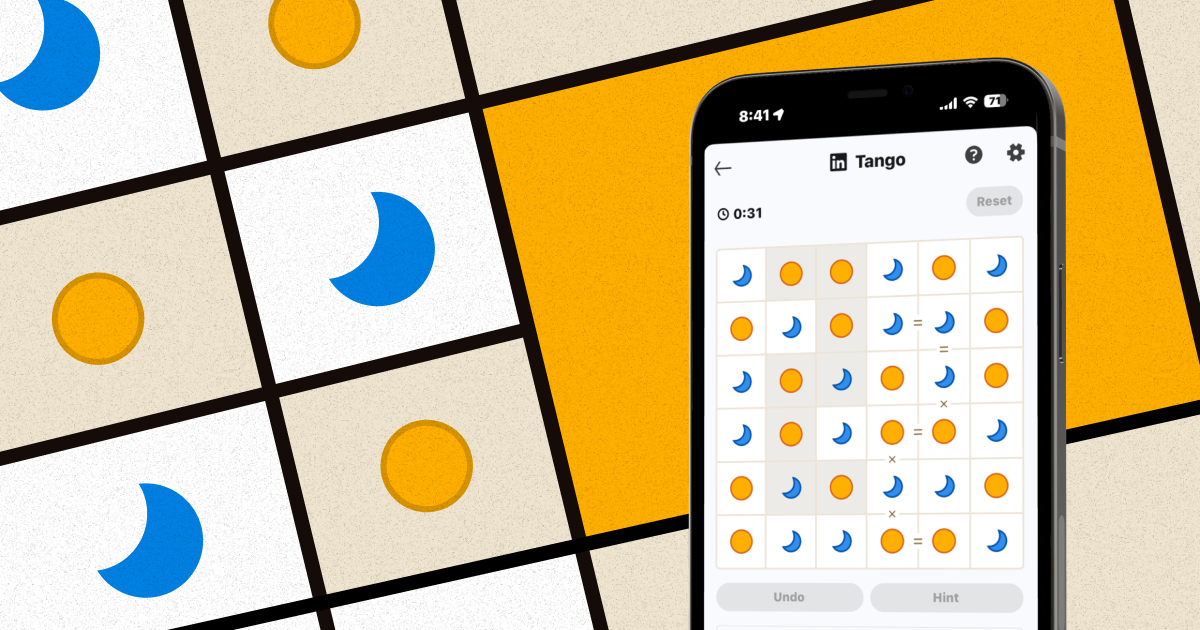
Tango is a daily logic game on LinkedIn, launched in 2024 as part of LinkedIn's games suite. It's a modern take on the classic binary puzzle tradition: the same core rules as Binairo and Takuzu, but with suns and moons instead of black and white circles, plus an extra layer of inter-cell clue markers.
The name is a nod to the dance. It takes two to tango, and every cell in a Tango grid holds exactly one of two symbols.
If you've played LinkedIn's Queens or Mini Sudoku, Tango will feel familiar. Small grid, hard constraints, one correct answer. The two-symbol system makes it simpler to learn than Queens and faster to solve than Sudoku.
And if you already know Tango and want to play more games like it, here are seven of the best games like Tango.
What Are the Rules of Tango?
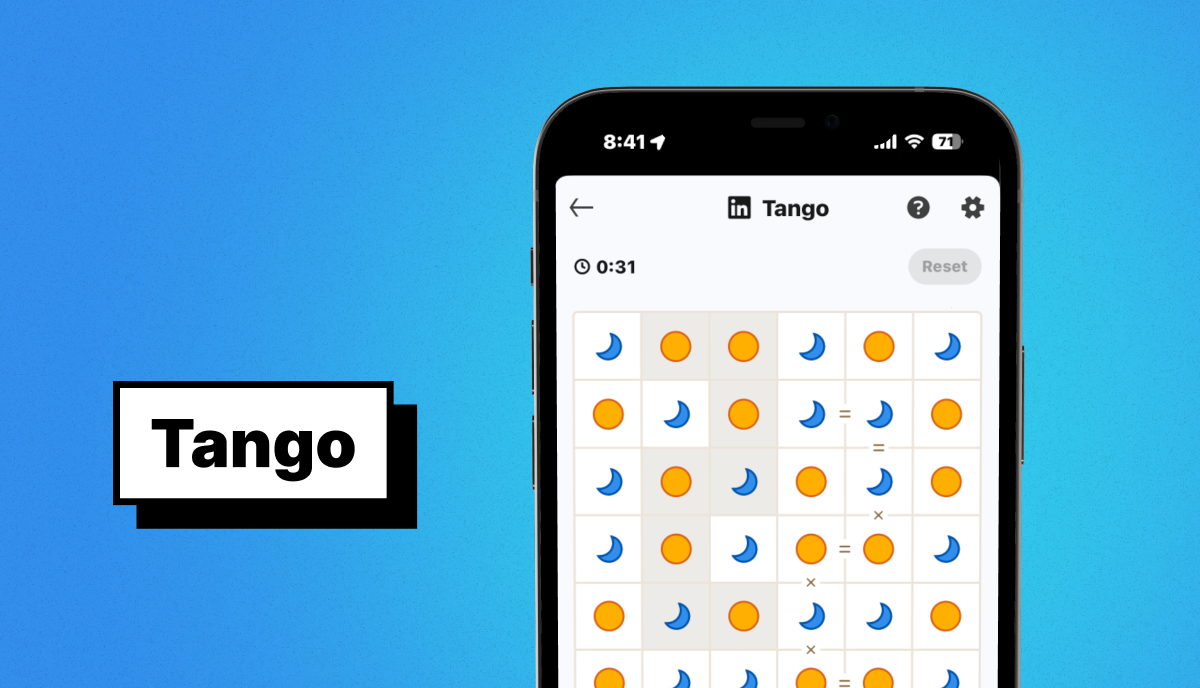
Three rules and two clue types. That's everything.
1. Row and column balance. Each row and each column must contain the same number of suns and moons. Tango is always a 6x6 grid, so every row and every column ends with exactly 3 suns and 3 moons.
2. No three in a row. Three moons in a row breaks the rule. Three suns in a row also breaks the rule. Whether you're looking at three moons stacked vertically or three moons sitting across a row, the constraint is the same: no three identical symbols adjacent in any direction. The three moons pattern and the three suns pattern are equally illegal.
Three moons in a row, either vertically or horizontally, is illegal. Three suns in a row, either vertically or horizontally, is also illegal. The same number rule keeps every row and every column balanced at three suns and three moons — so three moons stacked together or three suns stacked together always forces a correction somewhere.
3. Clue markers between cells. Small markers sit between some adjacent cells and give you extra information:
- An equals sign (=) between two cells means those cells separated by it must contain the same symbol. Two suns, or two moons.
- An × sign (also called the x sign) between two cells means those cells must contain different symbols. The x sign constraint works in pairs — one cell on each side of the x sign. Cells separated by an x sign always hold one sun and one moon.
Clue markers only apply to the pair of adjacent cells they sit between. An = sign between cells 3 and 4 tells you nothing about cell 5. It only relates the two cells on either side of it.
Every Tango puzzle has a single valid solution. If you're stuck, you're missing a deduction somewhere. The game doesn't punish you with bad luck.
How Do You Play Tango Step by Step?
The same five-step approach works on almost every Tango puzzle.
Step 1. Start where the information is densest. Scan the grid for the area with the most pre-filled cells, the most clue markers, or a row or column closest to full. Start there. That's where deductions cascade fastest.
Step 2. Apply the no-three-in-a-row rule. Look for rows or columns with two identical symbols adjacent to each other. The cell next to that pair has to be the opposite symbol. Also check for two identical symbols with a single gap between them. That gap cell has to be the opposite symbol, because filling it with the same one would create three in a row.
Step 3. Check row and column balance. After any placement, look at both the row and the column. If either one already has 3 suns, every remaining empty cell in that row or column must be a moon. Same number of each symbol per line, no exceptions.
Step 4. Use = and × clue markers to chain placements. Cells separated by an = sign share the same symbol. An × sign between cells forces them to be different. If you've determined one side of a clue marker, you've determined the other. Chains of clue markers often let you solve three or four cells off a single deduction.
Step 5. Re-scan after every placement. Every new symbol on the board changes what's deducible around it. A cell that wouldn't resolve three moves ago is often forced by the move you just made. Most stuck-feeling moments in Tango are missed re-scans.
A Worked Example: Solving a Tango Row
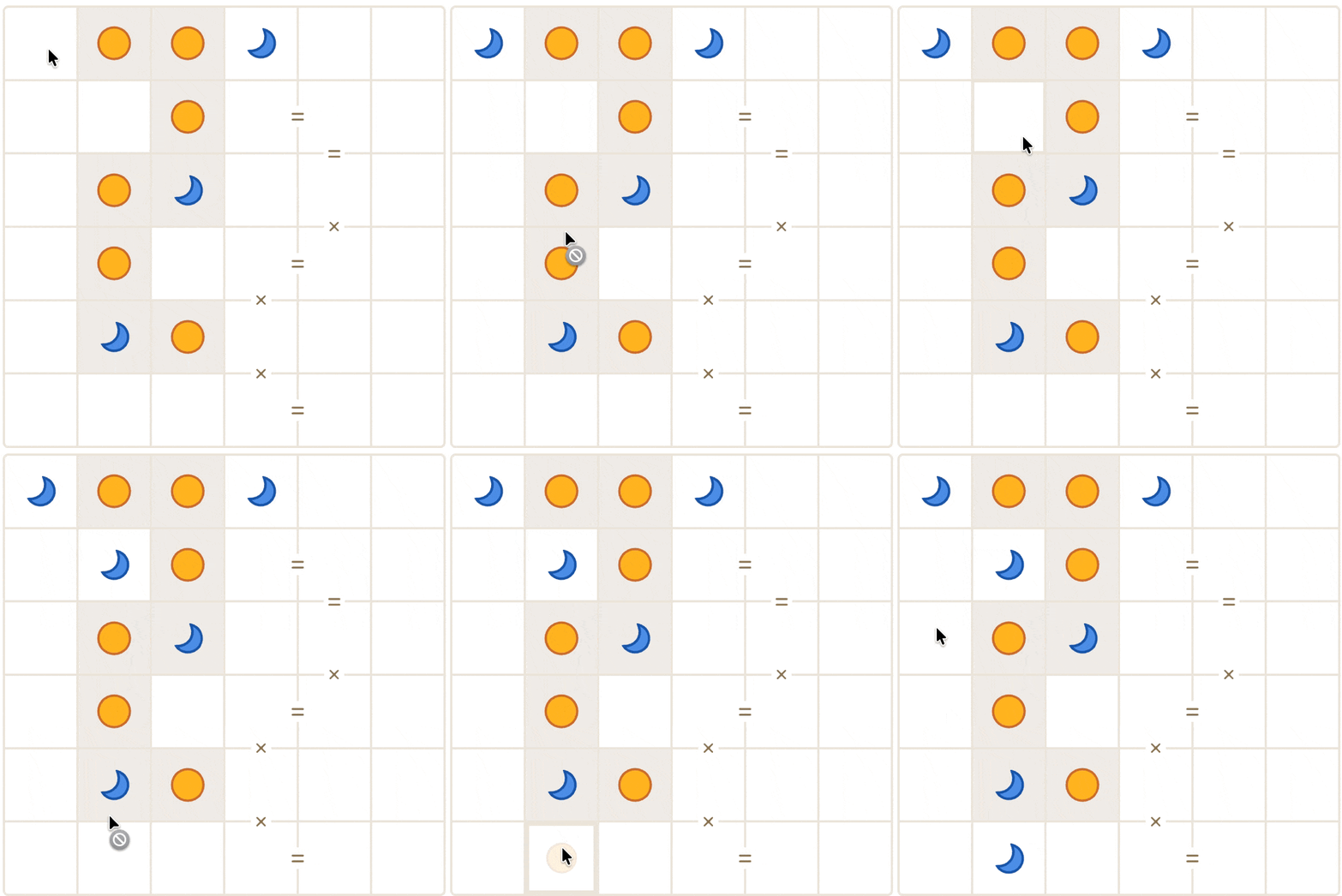
Say you're looking at a partial row at the top of a Tango grid:

Here's how the deductions play out.
First, the no-three rule. Cells two and three are both suns. If cell four were also a sun instead of a moon, the row would show three suns 🌙🌙🌙 and if the column had two moons above cell four, placing another moon would create three moons down the column. Cell four has to be a moon.

Second, row balance. The row now has 2 suns and 2 moons. It needs one more of each symbol to reach 3-and-3. That means cells five and six hold one sun and one moon between them, in some order.
Third, use the clue marker. Say there's an × between cells five and six. That × sign tells you the two cells separated by it must be different symbols, which matches what you already know from row balance. The × confirms the pairing but doesn't tell you the order yet.
Fourth, check the column. Look at the column containing cell five. If that column already has 2 suns placed, cell five can't be a third sun without unbalancing the column. So cell five is a moon, and by the × rule, cell six is a sun.
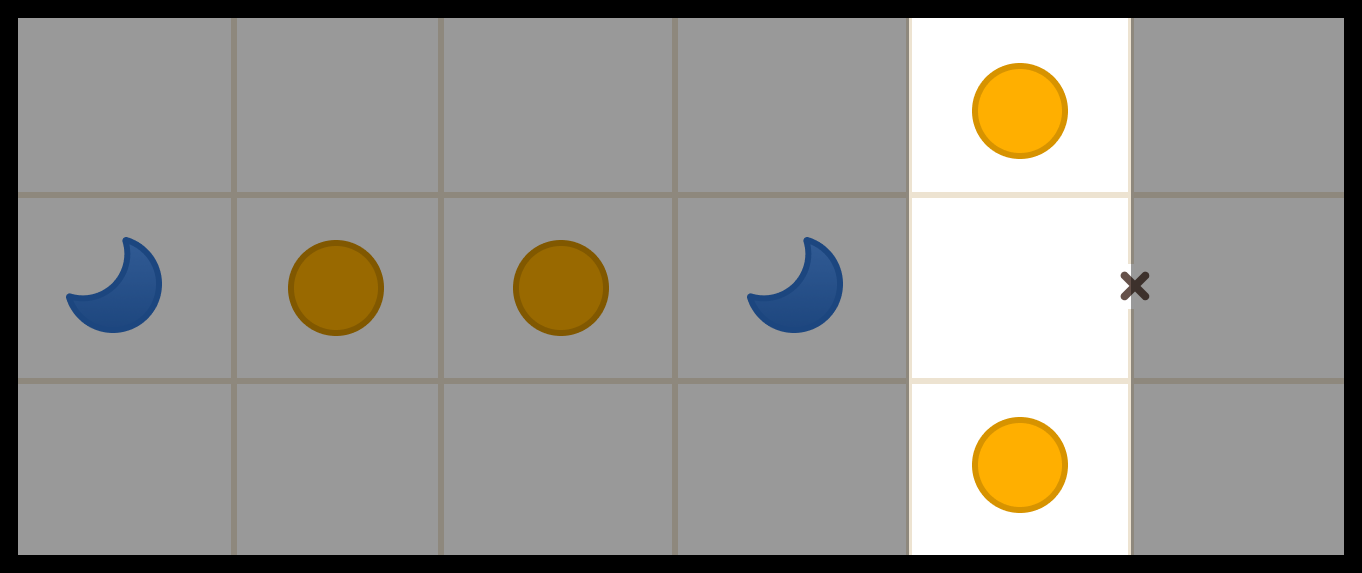
Row solved. Every move in a Tango puzzle works this way. You never have to guess.
What Patterns Should Beginners Look For?
A handful of shapes come up in every Tango puzzle. The faster you can spot them, the faster you solve.
The sandwich. Two identical symbols with a blank cell between them, like ☀️_☀️. That blank has to be the opposite symbol, because filling it with the same one would create three in a row.
The pair. Two identical symbols adjacent to each other. The cells immediately before and after that pair can't continue the same symbol, so both are forced to be opposite.
The near-full row or column. Any row or column with 3 of one symbol already placed. Every remaining empty cell must be the opposite.
The = chain. Cells separated by = clues all share the same symbol. A chain of three cells joined by = clues would force three of the same symbol in a row, which isn't allowed. So a valid = chain can only link two cells at most before something has to break it.
The × sandwich. If cells A, B, and C are connected so that A × B × C, then A and C must share the same symbol. Both are different from B, which means both are the same as each other.
What Are the Most Common Tango Mistakes?
New players tend to fall into the same handful of traps.
Ignoring column balance. Rows get all the attention because they're easy to read left-to-right. But every placement also affects its column. Check both.
Putting off the clue markers. The = and × signs are often the strongest information on the board. Don't save them for last. They give you two cells' worth of relationship at once, often from your very first scan.
Guessing when stuck. Tango always has a logical next move. If you can't find it, re-scan with fresh eyes. Placing a symbol just to see what happens builds a fragile position you'll unravel three moves later.
Jumping around the board. Working outward from a single dense area is almost always faster than bouncing across the grid.
Treating an = clue as global. An = sign tells you about exactly two adjacent cells. Not the whole row. Not the whole column. Just the pair it sits between.
How Do You Solve Tango Faster?
Speed comes from pattern recognition and scanning discipline. A few habits help.
Work one rule at a time per scan. Sweep the grid applying only the no-three rule first. Then do a second pass looking at row and column balance. Save the clue markers for last. Trying to juggle all three rules at once is how missed deductions happen.
Use clue markers to trigger chains. If a cell has an × clue to a neighbor, and that neighbor has an = clue to a third cell, resolving any one of the three resolves all three. Look for these linked pairs and triples.
Count mentally as you go. Keep a running count of suns and moons in the row and column you're actively working on. When either count hits 3, every remaining cell in that line is forced.
Drill the patterns in Unlimited. Pattern recognition comes from reps. One Tango per day on LinkedIn won't build muscle memory fast. If you want to drill patterns until they become instant reads, Flip Ultimate's Unlimited mode is built for exactly that.
Daily Tango vs Unlimited Play
LinkedIn's Tango is a daily puzzle. One new puzzle every 24 hours, one grid size, one difficulty level. That's ideal if you want a short daily ritual. It's a bottleneck if you're trying to learn the mechanics or build speed.
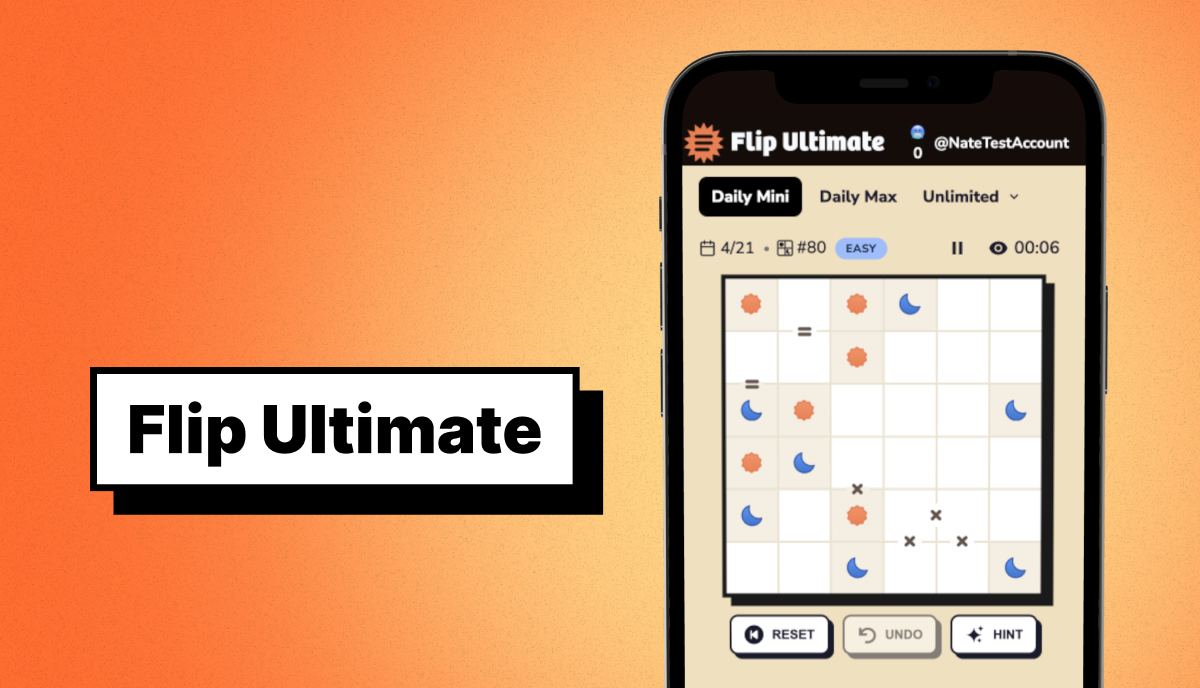
Flip Ultimate is a free sun-and-moon puzzle built on the same Binairo/Takuzu foundation as Tango, with three modes:
- Daily Mini. Smaller grid, faster solve. Good entry point if you're new to sun-and-moon puzzles.
- Daily Max. Full-size puzzle of the day, resets every 24 hours.
- Unlimited. Play as many as you want, at adjustable grid sizes and difficulty.
Flip Ultimate is not affiliated with LinkedIn. It's a standalone site in the Binairo/Takuzu tradition.
How Does Tango Compare to Binairo & Takuzu?
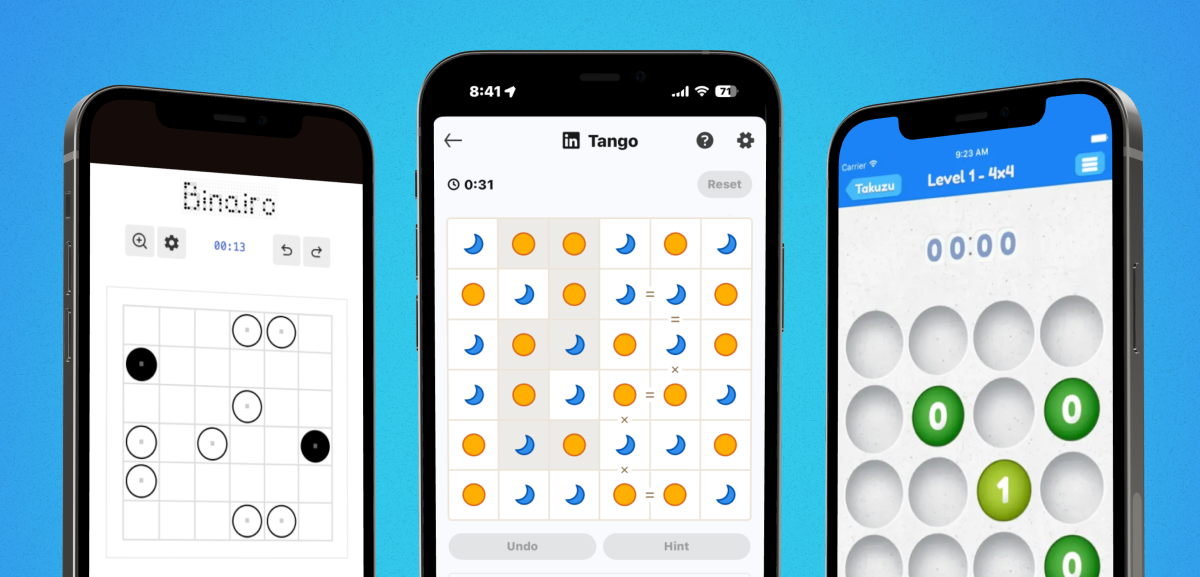
Tango sits inside a family of near-identical binary logic puzzles. Here's how they differ:
| Feature | Tango | Binairo | Takuzu |
|---|---|---|---|
| Symbols | Suns & moons ☀️🌙 | Black & white circles | 0s and 1s |
| Grid sizes | 6x6 fixed | Variable (8x8, 10x10, 14x14) | Variable |
| Clue markers | = and × between cells | None | None |
| Row/column balance | Equal count required | Equal count required | Equal count required |
| No three in a row | Yes | Yes | Yes |
| Unique rows/columns | Yes | Yes | Yes |
| Where to play | LinkedIn (daily) | Print, puzzle sites | Print, puzzle sites |
| Origin | LinkedIn, 2024 | Adriaan de Jong, 2009 | Japan, early 2000s |
The underlying logic is identical. Binairo and Takuzu are effectively the same puzzle with different symbols. Takuzu is the Japanese-tradition naming, Binairo is the Western branding popularized by Dutch puzzle publishers. Tango's twist is the = and × clue markers, which give you two-cell relationships directly instead of making you derive them from the no-three rule.
A same-size Tango and Binairo puzzle are roughly equivalent in difficulty. But the clue markers in Tango change how you solve. You spend less time scanning and more time chaining forced moves off the clue pairs.
How Does Flip Ultimate Compare to LinkedIn Tango?
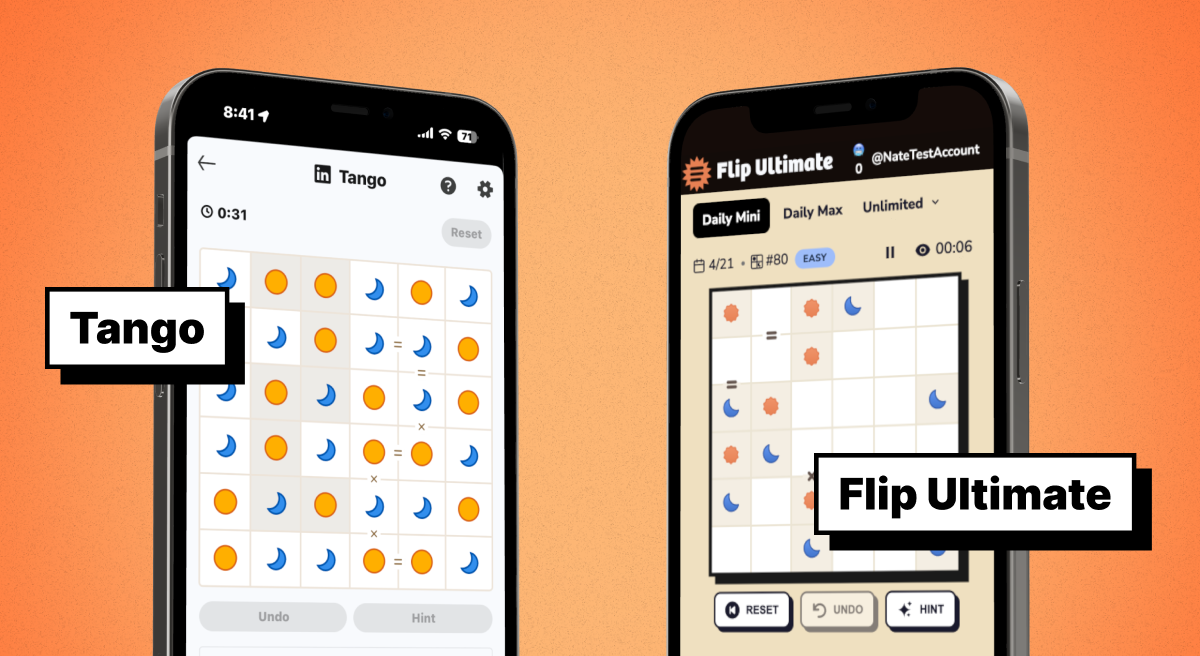
| Feature | LinkedIn Tango | Flip Ultimate |
|---|---|---|
| Grid size | 6x6 fixed | Daily Mini is smaller; Unlimited is adjustable |
| Daily puzzle | One per day | Daily Mini and Daily Max |
| Unlimited play | No | Yes |
| Difficulty adjustment | No | Yes (Unlimited mode) |
| Signup required | LinkedIn account | None |
| Cost | Free with LinkedIn | Free |
| Affiliated with LinkedIn | Yes | No |
Both use the same sun-and-moon binary mechanics with = and × clue markers. LinkedIn Tango is built into the LinkedIn platform and caps at one puzzle per day. Flip Ultimate is a standalone puzzle site with no signup, multiple play modes, and adjustable grids.
FAQ
Is Tango a skill game or a guessing game?
Tango is a pure skill game. Every puzzle has exactly one correct solution, reachable through deduction alone. If you're guessing, you've missed a logical step somewhere on the board.
Every Tango puzzle has a unique solution — one and only one correct arrangement. The unique solution is reachable through deduction alone. No guessing required.
What do = and × mean in Tango?
The equals sign and x sign are the two clue markers in Tango. The equals sign (=) between two cells means those cells must contain the same symbol: either two suns or two moons. The × sign between two cells means those cells must contain different symbols: one sun and one moon. These markers apply only to the pair of adjacent cells they sit between.
Is Flip Ultimate the same as LinkedIn Tango?
Flip Ultimate is not affiliated with LinkedIn. Both games use the same sun-and-moon binary mechanics, built on the Binairo and Takuzu puzzle tradition. But Flip Ultimate is a standalone site with multiple play modes, adjustable difficulty, and no signup.
How long does a Tango puzzle take to solve?
A 6x6 Tango typically takes three to seven minutes once you're comfortable with the rules. First-time players often take 10 to 15 minutes. Faster times come from pattern recognition, not shortcuts. You still have to work through it step by step.
What's the difference between Tango and Sudoku?
Sudoku uses nine different digits across a 9x9 grid divided into 3x3 boxes. Tango uses two symbols across a 6x6 grid with no box divisions, plus = and × clue markers. Tango is much closer to Binairo: binary instead of nine-symbol, smaller grid, different clue system.
Can you play more than one Tango per day?
Not on LinkedIn. LinkedIn Tango is strictly one puzzle per day, resetting at midnight in your local time zone. For unlimited sun-and-moon puzzle play, standalone sites like Flip Ultimate offer an Unlimited mode with as many puzzles as you want.
Is there a LinkedIn Tango app?
LinkedIn Tango is played inside the LinkedIn app or on linkedin.com. There's no dedicated LinkedIn Tango standalone app. Several third-party puzzle sites offer Tango-style games in a browser or through their own apps.
Why is it called Tango?
The name is a nod to the phrase "it takes two to tango." Every cell has exactly two possible values, and every clue marker applies to exactly two cells.
Play a Tango-Style Puzzle Today
Three modes, three different kinds of players:
- New to the mechanics? The Daily Mini is a smaller grid with the same rules. Gentler on-ramp.
- Want your daily puzzle fix? The Daily Max resets every 24 hours.
- Drilling patterns? Unlimited mode gives you unlimited puzzles at adjustable grid sizes and difficulty. The fastest way to build pattern recognition.
If logic puzzles are your broader interest, Queens Ultimate is a companion puzzle built on similar deduction mechanics, and the daily logic word games roundup on the Crosswordle blog covers the LinkedIn-adjacent puzzle landscape more broadly.
 Mini Crossword
 Midi Crossword
 Diffle
 Killer Sudoku
 Numberle