Binairo vs Takuzu vs Tango: The Binary Logic Puzzle Family, Explained
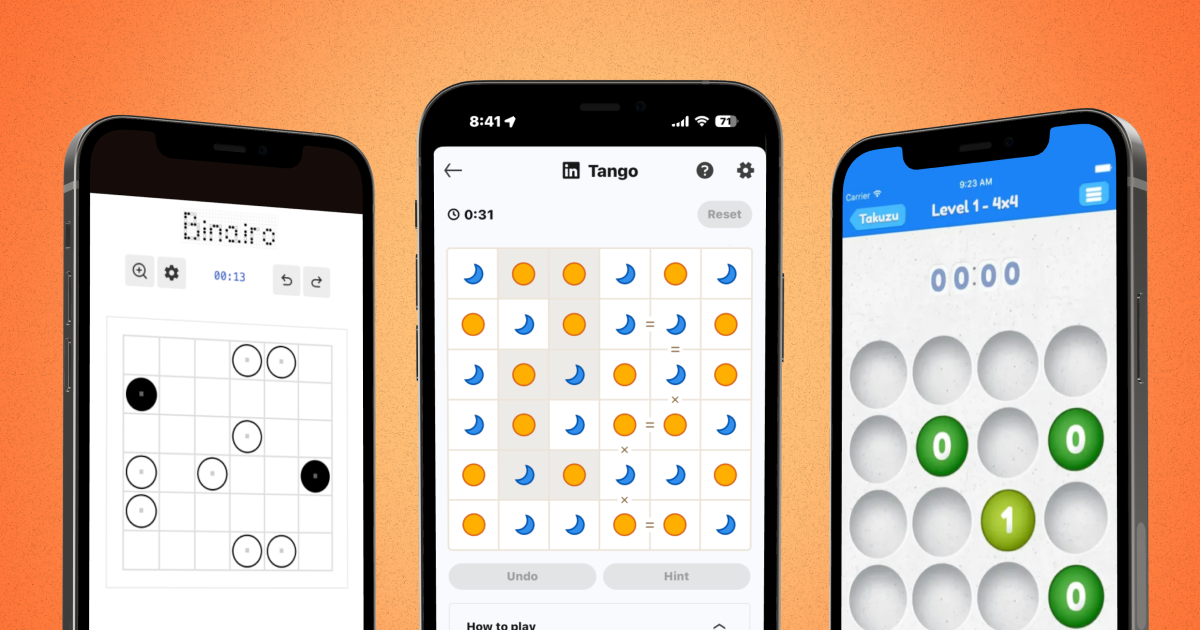
Binairo. Takuzu. Tic Tac Logic. Tango. If you've spent any time in the grid-puzzle corner of the internet, you've probably run into all four, usually with someone insisting one of them is "the original." Here's what's actually going on.
Quick Comparison Table
| Feature | Binairo / Takuzu / Tic Tac Logic | Tango |
|---|---|---|
| Puzzle family | Binary logic puzzle | Binary logic puzzle |
| Symbols | 0s and 1s, black and white circles, or Xs and Os | Orange suns and blue moons |
| Common grid sizes | 4×4 up to 20×20 (larger sizes exist, up to 30×40) | 6×6 (LinkedIn); variable in apps like Flip Ultimate |
| Equal count per row and column | Yes | Yes |
| No three of the same symbol in a row or column | Yes | Yes |
| No duplicate rows or columns | Yes (in most variants) | Not explicitly stated — 6×6 grid makes it moot |
| Inter-cell = and × clue markers | No | Yes (the core new mechanic) |
| Year introduced | 2009 (Binairo); earlier roots in Tohu-Wa-Vohu | October 2024 |
| Where you'll see it | Puzzle books, newspapers, Conceptis apps, puzzle-binairo.com | LinkedIn (daily), Flip Ultimate |
Short answer: are Binairo, Takuzu, and Tango the same game?
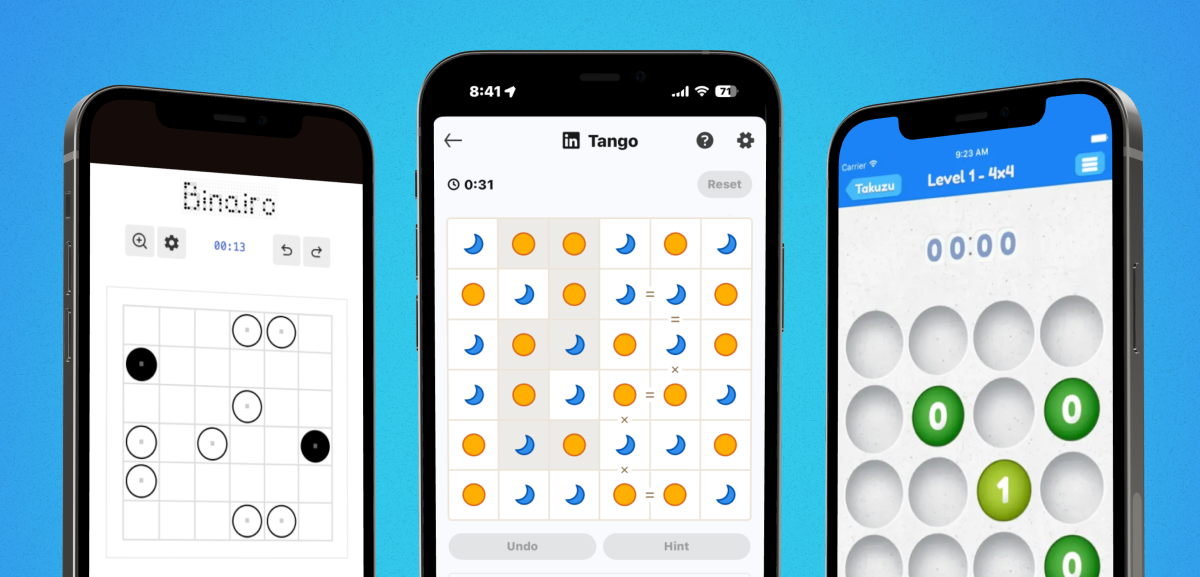
Binairo and Takuzu are the same game. So is Tic Tac Logic. They're different trademarked names for the same binary logic puzzle, picked by different publishers in different regions. Tango is a close cousin, not an identical twin — it shares the core rules but adds inter-cell constraint symbols (= and ×) that don't exist in the others.
If that's all you came for, you're done. If you want the why, read on.
What is Binairo?
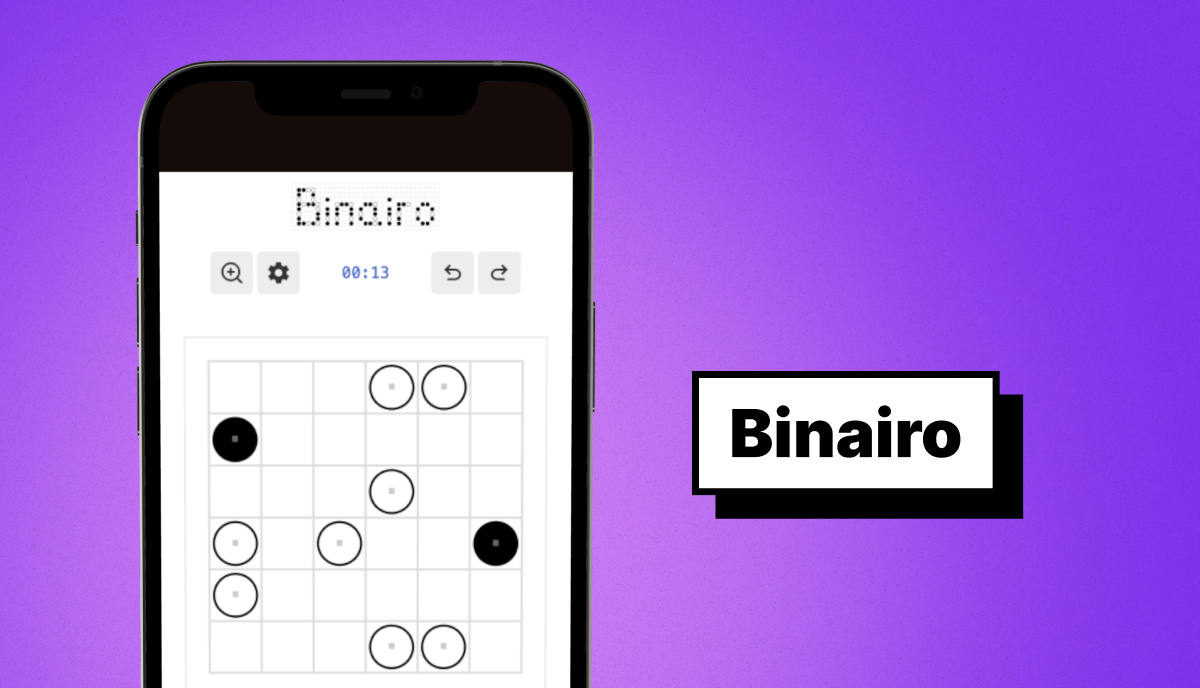
Binairo is a binary logic puzzle played on a rectangular grid. You fill every cell with one of two symbols — typically 0s and 1s, or black and white circles — under three rules: each row and column has an equal number of each symbol, no three of the same symbol can appear adjacent in a row or column, and no two rows or columns can be identical.
The puzzle was created in 2009 by Belgian designers Peter De Schepper and Frank Coussement, the duo behind PeterFrank (later PeterFrank Media). It ran in Belgian and Dutch newspapers under the Binairo name, then spread through European puzzle magazines and syndication. The name "Binairo" is trademarked in the European Union, which is why you'll see it dominant in French, Dutch, and German-speaking markets and less common in the US.
Rules:
- Each row and each column must contain an equal number of 0s and 1s (or whichever two symbols are in use).
- No more than two of the same symbol can sit adjacent in a row or column.
- No two rows can be identical, and no two columns can be identical.
Every Binairo puzzle starts with a handful of pre-filled cells and has exactly one valid solution. No guessing required. It's always solvable with pure logic.
Grid sizes commonly range from 4×4 to 20×20. Larger grids exist, including a 30×40 variant that's more of an evening's project than a coffee-break puzzle. An "Odd Binairo" variant uses odd-numbered grids where each row and column has one more 1 than 0.
What is Takuzu?
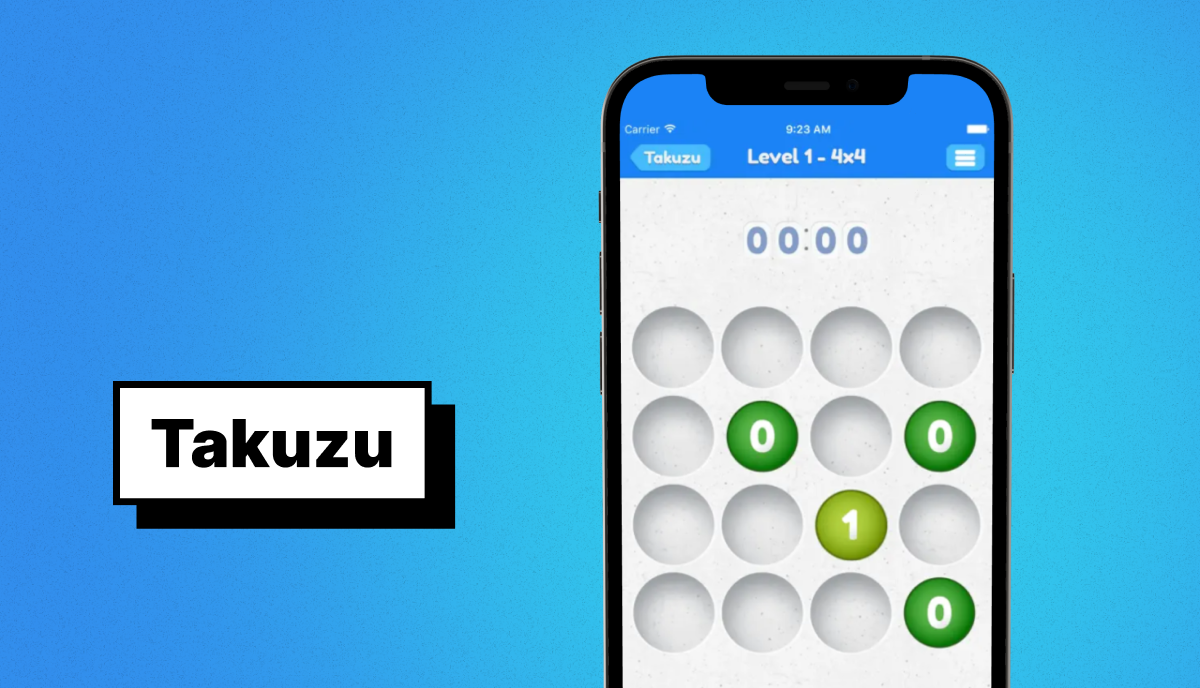
Takuzu is the same puzzle as Binairo with a different name. The rules are identical. The grid is the same. Only the marketing changed.
"Takuzu" was chosen to ride on Sudoku's coattails. The name is meant to sound Japanese, which by the mid-2000s had become shorthand for "serious logic puzzle." The trick worked — Takuzu picked up traction in markets where Binairo's European branding didn't travel as well, and "Takuzu" became the more common search term in English-speaking regions. Like Binairo, Takuzu is trademarked in the EU.
You'll also see the same puzzle sold as Binero (trademarked in France by Editions Megastar), Binoxxo (German-speaking markets), Tohu-Wa-Vohu (the Italian variant credited to Adolfo Zanellati, created around the same time as Binairo), Eins und Zwei, Zernero, Binary Puzzles, and Sudoku Binary. Same puzzle, different regional branding.
If it helps: Binairo, Takuzu, and the rest are to binary logic puzzles what "cilantro" and "coriander" are to the herb. Different words, same thing, strong regional preferences.
What is Tic Tac Logic?
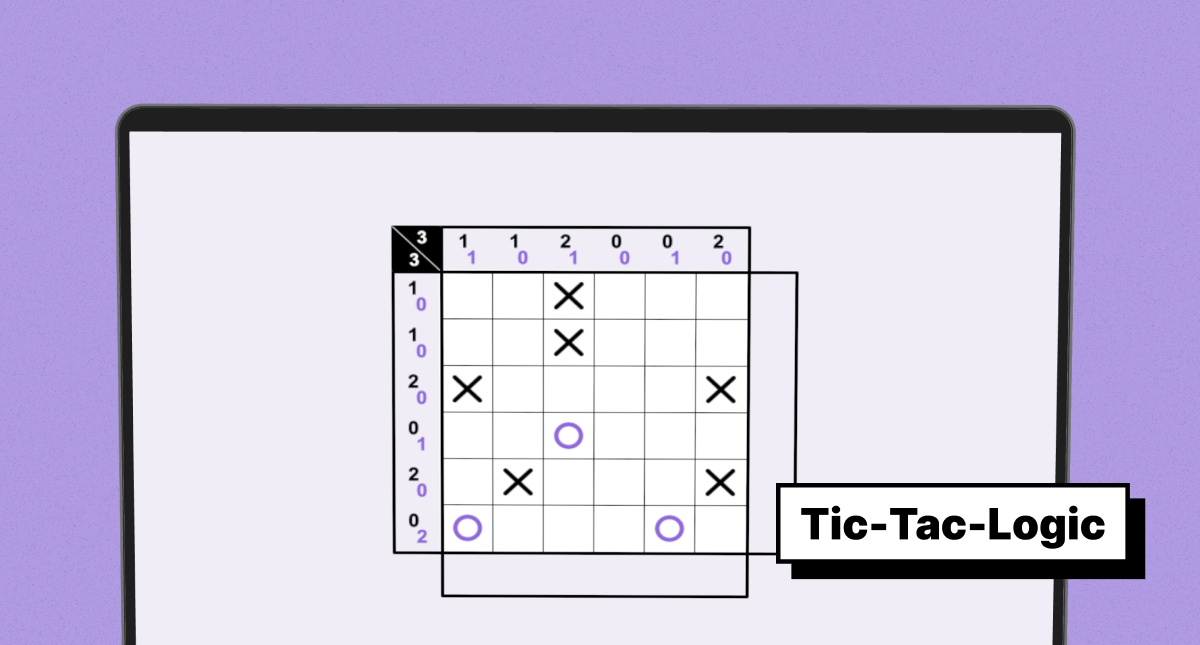
Tic Tac Logic is the version of Binairo published by Conceptis Puzzles, one of the largest logic-puzzle syndicators in the world. Conceptis is based in Haifa, Israel, and claims more than 20 million of their puzzles are solved daily across newspapers, magazines, books, and apps. Tic Tac Logic uses Xs and Os instead of 0s and 1s, and plays on grid sizes up to 18×24.
Here's the part worth getting straight: the puzzle has nothing to do with tic tac toe, the pencil-and-paper game you played as a kid. The "tic tac" branding leans on the visual similarity — two symbols, grid format — but the games play opposite. In the children's version, you're trying to get three in a row. In this one, you're trying to prevent it, while balancing the number of Xs and Os across the grid.
It's Binairo with Xs and Os. Same rules, same solving techniques, same single-valid-solution guarantee.
If you've ever played a puzzle in a newspaper that looked like Binairo but had a different name on it, you weren't imagining things.
What is Tango?
Tango is LinkedIn's 2024 take on the binary logic puzzle. It launched in October 2024 as part of LinkedIn's growing puzzle suite — Queens came first, then Tango, then Zip, Pinpoint, and Crossclimb. If you're coming from LinkedIn, Tango is the sun-and-moon one.
The rules are the binary logic puzzle rules you already know, with one addition:
- Each row and each column must contain an equal number of suns and moons (three of each in the standard 6×6 grid).
- No more than two of the same symbol can sit adjacent in a row or column.
=and×clue symbols appear between some adjacent cells. An=means the two cells it connects must hold the same symbol. An×means they must hold different symbols.
That third rule is the whole game. It's what makes Tango feel different from Binairo even though the underlying logic family is the same. In Binairo, every inference comes from the balance rule or the no-three rule. In Tango, the clue symbols often resolve first and cascade into the rest of the grid faster than balance or no-three would on their own.
The name comes from the phrase "it takes two to tango" — fitting for a puzzle built around two symbols and pair-based clues. LinkedIn isn't affiliated with PeterFrank or Conceptis; Tango is its own take on a public puzzle format.
For a full walkthrough of how to actually solve a Tango puzzle — including how to use the = and × clues efficiently — see our Tango solving guide.
What's the difference between Binairo and Tango?
The short answer: Tango has extra clue symbols; Binairo doesn't. The longer answer is about how that changes the solving experience.
Binairo is pure balance and adjacency logic. Every deduction traces back to one of two facts: either the row or column is almost full so the remaining cells must contain the other symbol, or two adjacent cells share a symbol so the next cell must flip. That's it. Larger Binairo grids (12×12 and up) get hard because the chains of reasoning get longer, not because the rules get more complex.
Tango is balance and adjacency logic plus inter-cell constraints. The = and × clues act as forced pairs — they tell you that two specific cells must match or differ, regardless of anything else happening in the row or column. On a 6×6 grid, a single × clue often gives you two filled cells immediately, which then cascades into neighboring cells via the no-three-in-a-row rule.
Which is "harder" depends on what you mean. Binairo at larger sizes is more demanding in terms of pure deduction depth. Tango at 6×6 is tighter and clue-driven, with less room to maneuver but faster payoff when you spot a key ×. They're different kinds of difficulty.
How do solving techniques differ?
The core techniques all three puzzles share:
- Complete by balance. If a row or column already has the maximum of one symbol, the remaining cells must contain the other. A row of six cells with three suns already placed? The rest are moons.
- Break up pairs. If two adjacent cells hold the same symbol, the cells on either side must hold the opposite. Otherwise you'd get three in a row, which the rules don't allow.
- Close the gap. If two cells contain the same symbol with one empty cell between them, the empty cell must hold the opposite — otherwise three in a row again.
- Eliminate the impossible. Sometimes you can rule out a symbol in a cell by showing that placing it would force a rule violation somewhere down the line. Place a sun, look forward, see that the remaining cells can't balance without a trio — so the cell must be a moon.
For Tango specifically, you add one more technique:
- Solve the clues first. An
=or×clue gives you a locked pair. Even if you don't know what symbol each cell holds, you know they match (on=) or differ (on×). That constraint propagates. Many Tango puzzles are fastest solved by starting with the longest chain of clues and working outward from there. The trick is recognizing when a clue chain locks enough cells that the rest of the row must be arranged in such a way that the balance and no-three rules resolve it automatically.
The "eliminate the impossible" move is the one that separates casual solvers from fast solvers. On a 6×6 Tango, placing a symbol tentatively and checking a few cells ahead will often show whether your guess breaks the grid. That's not guessing — it's proof-by-contradiction, and it's a legitimate solving tool across the whole binary puzzle family. When the remaining cells in a row can only be filled in such a way that three of the same symbol appear somewhere, you've just proven the original placement wrong.
Which puzzle should you play?
Binairo or Takuzu if you want:
- Larger grids and longer sessions (10×10 and up is where these get interesting)
- A pure logic puzzle with no visual gimmicks
- A format that's been battle-tested in puzzle books for 15+ years
Tic Tac Logic if you want:
- The same puzzle with an Xs-and-Os visual that reads faster than 0s and 1s
- Access to Conceptis's library of hand-crafted puzzles at difficulty levels from easy to extremely hard
Tango if you want:
- A tighter, clue-driven version that solves in 2-5 minutes once you know the technique
- A daily puzzle habit without hunting down a puzzle book
- The sun-and-moon visual, which a lot of people find more fun than circles
None of them are "better." They're different flavors of the same underlying puzzle. The right one is whichever you'll actually play.
Where can you play Binairo, Takuzu, and Tango online?
- Binairo: puzzle-binairo.com has daily grids from 6×6 up to 14×14 plus a 30×40 monthly challenge. PeterFrank's own site carries the original version.
- Binary Puzzles: binarypuzzle.com offers a similar daily archive in the generic "Binary Puzzles" branding.
- Tic Tac Logic: Conceptis Puzzles' Tic-Tac-Logic: X or O? is available on iOS and Android, plus appears in syndicated newspaper puzzle sections.
- Tango: LinkedIn serves one Tango puzzle per day through the LinkedIn app and website. You need a LinkedIn account to play.
- Flip Ultimate: flipultimate.com runs the Tango-style format (sun and moon symbols,
=and×clue constraints) with three modes: Daily Mini for a quick session, Daily Max for the full-size daily puzzle, and Unlimited for as many puzzles as you want on your own schedule. No signup, no account, free.
If you're coming in cold and want to try the sun-and-moon version first, the Daily Mini is the gentler on-ramp — smaller grid, shorter session, same rules.
FAQ
What is a binary puzzle?
A binary puzzle is a logic puzzle played on a grid where every cell holds one of two symbols — typically 0s and 1s, or black and white circles, or in Tango's case, suns and moons. The core rules are an equal number of each symbol per row and column, no three of the same symbol adjacent in a row or column, and usually no duplicate rows or columns. Binairo, Takuzu, Tic Tac Logic, Binoxxo, and Tango are all binary puzzles.
Is Binairo the same as Takuzu?
Yes. Binairo and Takuzu are trademarked names for the exact same puzzle. The rules are identical: same grid, same balance requirement, same no-three-in-a-row rule, same uniqueness rule. Binairo is the more common name in European markets; Takuzu is more common in English-speaking markets. Both trademarks are held in the EU.
Is Tic Tac Logic the same as Binairo?
Yes. Tic Tac Logic is Conceptis Puzzles' brand name for the Binairo format, using Xs and Os instead of 0s and 1s. The rules are identical. The "tic tac" in the name refers to the choice of symbols, not to any rule overlap with the children's game of the same naming style.
Is Tango the same as Binairo?
Close, but not identical. Tango inherits the core Binairo rules (equal counts per row and column, no three of the same symbol adjacent) but adds a new mechanic: = and × clue symbols between adjacent cells that force those pairs to match or differ. That mechanic doesn't exist in Binairo, Takuzu, or Tic Tac Logic.
Why is it called Tango?
The name plays on "it takes two to tango" — a fitting reference for a puzzle built around two symbols (suns and moons) and pair-based clues (= meaning match, × meaning differ). LinkedIn launched the puzzle under this name in October 2024.
Can you play Tango without a LinkedIn account?
Not LinkedIn's version. LinkedIn's Tango is locked behind a LinkedIn account and serves one puzzle per day. If you want the same format without the account requirement, Flip Ultimate runs the sun-and-moon style in three modes (Daily Mini, Daily Max, and Unlimited) with no signup.
What's the biggest Binairo grid?
Common sizes range from 4×4 to 20×20. Larger grids exist — puzzle-binairo.com publishes a monthly 30×40 Binairo that's about as big as the format gets before it becomes a job rather than a game.
Is Binairo harder than Sudoku?
Binairo and Sudoku aren't directly comparable. The deduction styles are different: Binairo leans on balance and adjacency, while Sudoku leans on constraint propagation across rows, columns, and subgrids. Most puzzle solvers who know both say a 10×10 Binairo is roughly as demanding as a standard 9×9 Sudoku, but in a different way.
Is Tic Tac Logic the same as tic tac toe?
No. They share visual DNA (Xs and Os on a grid), but the rules and goals are different. Tic tac toe is a two-player game where you're trying to get three of your symbol in a row. Tic Tac Logic is a single-player logic puzzle where you're trying to fill a grid so that no three of the same symbol sit adjacent, while keeping equal counts per row and column. Same symbols, opposite goals.
Keep solving
If this is your first binary logic puzzle and you want to try the sun-and-moon version, the Daily Mini is a good place to start — 4×4 or 6×6, quick session, same rules explained with a cleaner interface than LinkedIn's.
If you already play Tango daily on LinkedIn and ran out at one puzzle per day, Flip Ultimate's Unlimited mode runs as many as you want, with adjustable grid size and difficulty.
For a full breakdown of how to solve a sun-and-moon puzzle step by step — the techniques above applied to an actual grid — read our how to play Tango guide.
About
Written by Nate at Hey, Good Game, a small studio that builds and buys brain games. We run Crosswordle, Wordga, Queens Ultimate, Flip Ultimate, and a few others. If you like logic puzzles, the daily roundup at Crosswordle covers what's worth playing across the genre.
 Mini Crossword
 Midi Crossword
 Diffle
 Killer Sudoku
 Numberle