How to Play Binairo: The Complete Rules, Strategy and Solving Guide
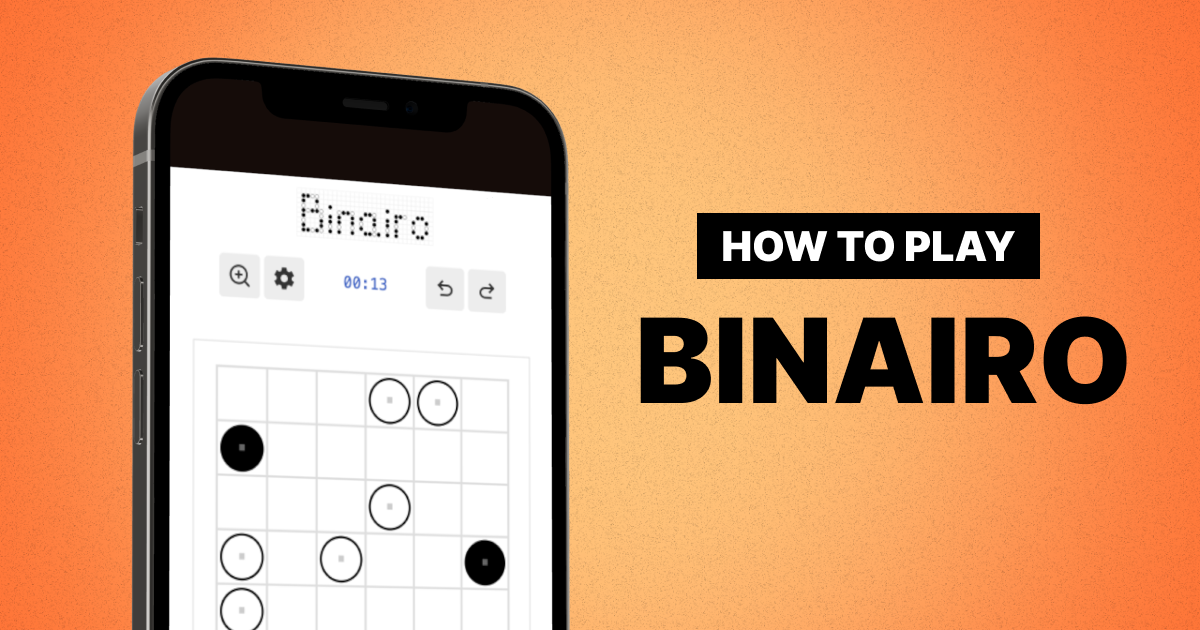
Binairo is a binary logic puzzle played on an even-sized grid where every cell holds one of two symbols, governed by three simple rules. If Sudoku, Nonograms or LinkedIn's Tango already have a hold on you, Binairo will feel familiar: same logic core, shorter sessions, easier on-ramp from beginner to confident solver.
One quick note on names: Binairo, Takuzu, Tic-Tac-Logic and Binary Puzzle are the same puzzle under different labels. The rules are identical; the names changed as the puzzle traveled across newspapers and apps. The full breakdown lives in our Binairo vs. Takuzu vs. Tango piece. This guide focuses on how to play and solve.
By the end you'll learn the three rules, four solving techniques that handle most grids and a place to play a daily Binairo-style puzzle without ads or sign-ups.
What Is Binairo?
Binairo is a binary logic puzzle played on an n×n grid where n is always even — usually 6, 8, 10, 12 or 14. The job is to fill every cell with one of two symbols. Traditionally that means 0s and 1s, though modern versions use suns and moons, black and white circles, or other paired motifs. Three rules govern every valid solution. No guessing required, ever.
The puzzle has a conflicting history, but is known to have been made around 2009. The three known creators of the original versions are the Italian-Belgian puzzle designer Adolfo Zanellati and the Belgian duo Peter De Schepper and Frank Coussement. It has since picked up other names — Takuzu, Tic Tac Logic, Binary Puzzle — but the rules never changed.
The Three Rules of Binairo
Every Binairo puzzle has exactly one solution, reachable through pure logic. These three rules are the whole game.
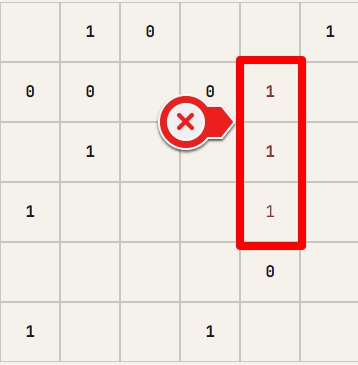
Rule 1: No three in a row of the same color/symbol
Two of the same symbol next to each other, horizontally or vertically, is fine. Three is illegal. Sun-sun-sun (or 1-1-1) never works in any direction; sun-sun-moon (or 1-1-0)does. The rule applies to rows and columns equally.
Rule 2: Equal counts of each symbol per row and column
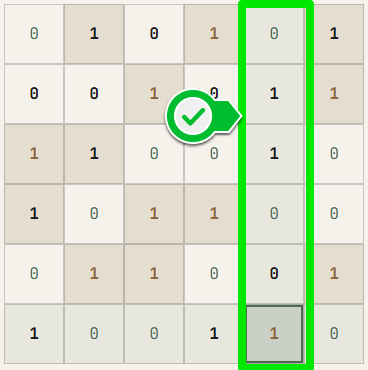
On a 6×6 grid, every row holds three suns and three moons. Every column does too. On an 8×8 grid, four and four. The rule scales with grid size: half and half, always.
Rule 3: No two rows or columns can be identical
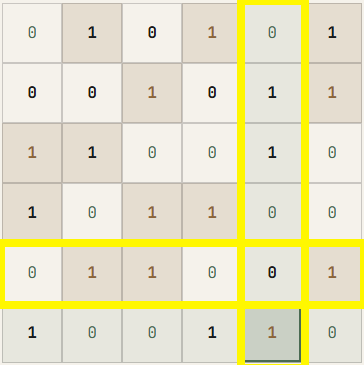
This is the rule that separates Binairo from its LinkedIn cousin Tango. Once a row is complete, no other row in the puzzle can match it exactly. Same for columns. The constraint sounds restrictive because it is, and it powers Binairo's most useful solving technique.
But keep in mind, a row and column can be identical, but row-row or column-column can't.
Four Solving Techniques That Handle Most Grids
These four techniques cover the vast majority of Binairo grids, including most labeled "hard." The fourth is the one that separates beginners from intermediate solvers.
1. Pair completion
Two of the same symbol side by side mean the cells flanking them are the opposite.
- 1-1-? becomes 1-1-0.
- ?-0-0 becomes 1-0-0.
Easiest technique in the kit. You'll use it on every grid.
2. Triple blocking
Sometimes you have a 1, a gap and another 1: 1-?-1. The middle cell has to be a 0, since three 1s in a row would violate Rule 1. This is sandwich logic, and naming it helps because beginners miss it until their eyes are trained for it.
3. Counting to balance
The moment one symbol hits its row or column quota, every remaining cell in that row or column is the other symbol. On a 6×6, the third 1 in a row means the other three cells are all 0s. Sounds obvious, but it gets overlooked when adjacency rules are eating attention.
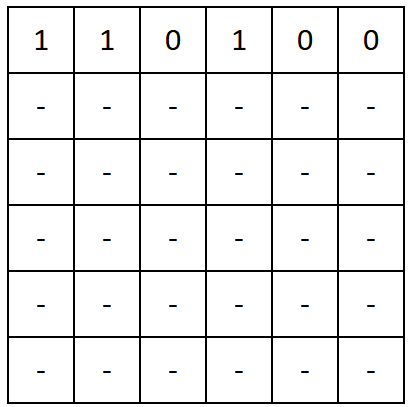
4 Uniqueness elimination
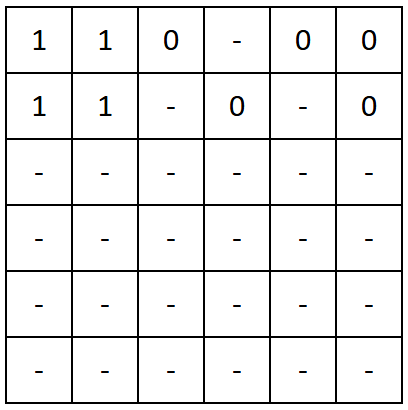
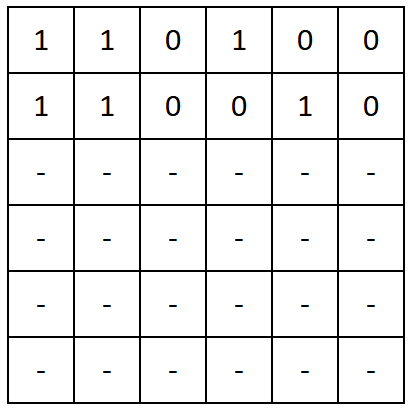
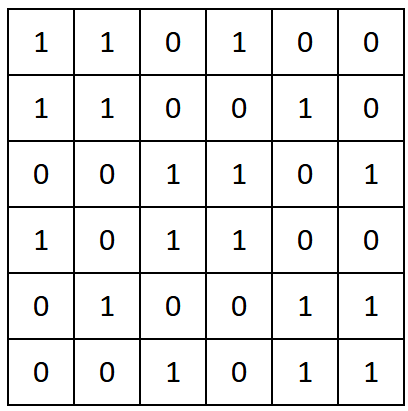
Two rows are nearly identical, with one or two cells still blank. Whatever value would make them match is forbidden by Rule 3, so those blank cells get forced to the opposite value.
This is Binairo's signature technique and the one beginners skip past. When a grid feels stuck and pair completion isn't moving, scan for near-twin rows and columns. The forced cells are usually sitting there waiting.
Difficulty Levels and Grid Sizes
Binairo grids come in five common sizes: 6×6, 8×8, 10×10, 12×12 and 14×14. Some publishers offer 16×16 and 20×20 for serious solvers. Size affects how long a puzzle takes, but it isn't the only difficulty lever.
Easy puzzles lean on pair completion and triple blocking. They solve top-to-bottom without much pattern recognition. Harder puzzles bury the obvious moves and force solvers into uniqueness elimination. The no-duplicate-rows rule does the heavy lifting at expert level.
For newcomers, 6×6 or 8×8 is the sweet spot. The full ruleset shows up without burning 30 minutes per grid. Once uniqueness elimination feels natural, move up to 10×10 and beyond.
There's also an "Odd Binairo" variant played on odd-sized grids (like 11×11), where each row and column contains one more 1 than 0. Same logic, slight twist.
Binairo vs. Takuzu vs. Tic Tac Logic vs. Tango
The same puzzle has worn several names. Here's how the variants compare:
Feature | Binairo | Takuzu | Tic-Tac-Logic | Tango |
Origin | Disputed creator, but published in Belgium | Newspaper syndication | App publishers | LinkedIn® |
Grid sizes | All available | All available | Varies depending on publisher | 6×6 |
3 rules? | ✅ | ✅ | ✅ | ❌ Only has 2 |
Cell clues? | ❌ | ❌ | ❌ | ✅ |
Symbols |
|
| Varies | ☀️s & 🌙s |
Minus Tic-Tac-Logic, a full breakdown lives in our Binairo vs. Takuzu vs. Tango piece.
Where To Play Binairo Online
A handful of solid options exist. Most "Binairo apps" are puzzle generators with thin UX: generic interface, ad-heavy, no daily ritual to anchor the habit. Skip those.
Flip Ultimate runs a Daily Mini (1 set of 6×6) and Daily Max (3 sets of 6×6), unlimited replay, no sign-up required. The interface layers clue markers on top of the classic Binairo ruleset. For the strict three-rule challenge, ignore the markers and the logic still works. This is the closest thing to a contemporary Binairo experience, and it's free.
Conceptis is one of the oldest publishers and still hosts a strong library. They earned the credit, as they helped bring Binairo to a global audience. Their puzzles stay pure to the classic ruleset.
BinaryPuzzle.com runs a deep archive of free puzzles in 6×6 through 14×14, with a daily puzzle and a difficulty range from very easy to very hard. The interface is dated but functional, and the puzzle quality is high.
Many newspaper syndications (especially German ones) still carry Binairo (often as Takuzu) in print and online editions. Check the puzzles section of a paper (or e-paper) that you know still puts puzzles in its issues.
For a polished daily ritual without ads or paywalls, Flip Ultimate and LinkedIn's Tango are the live options worth your time.
Frequently Asked Questions
Are Binairo puzzles the same as Takuzu?
Yes. Binairo and Takuzu are the same puzzle under two names. Takuzu is just the name used in newspaper syndication in some markets to take advantage of the Sudoku craze at the time. Same three rules, same solving logic.
Is Binairo the same as Tango?
Almost. They belong in the same puzzle family, but LinkedIn's Tango drops the no-duplicate-rows rule (Rule 3 in Binairo) and adds adjacent-cell clue markers (= and ×) that tell you which neighboring cells must match or differ. The core grid logic is shared; the rule sets diverge.
Can I play Binairo unlimited?
Yes. Flip Ultimate's Unlimited mode offers continuous Binairo-style puzzles with no daily cap. The classic Conceptis library is extensive enough to function as unlimited play, and BinaryPuzzle.com has thousands of free puzzles in its archive.
Is Binairo harder than Sudoku?
Generally easier at the same grid size. A 6×6 Binairo solves faster than a 6×6 Mini Sudoku, since there are only two symbols to track and only three rules to apply. At expert difficulty the gap narrows, since uniqueness elimination demands strong pattern recognition.
Is there a Binairo app?
Yes, several. Each different dev group or publisher puts their own spin on the classic formula. Flip Ultimate runs a web-based Binairo-style game playable on any device without a download. Most third-party apps are unofficial generators of varying quality.
Is Binairo good for your brain?
Logic puzzles like Binairo exercise working memory and pattern recognition. The research on long-term cognitive benefits is mixed; puzzles don't prevent dementia or measurably raise IQ directly. They are, however, a low-stakes way to spend 5 minutes practicing constrained logical reasoning. That's useful on its own.
Try a Binairo-Style Binary Puzzle Today
The Daily Mini at Flip Ultimate is the right starting point: 6×6 grid, light ruleset, done in under 5 minutes. The Daily Max consists of three 6x6 puzzles, scaled up for solvers who want more cells to work through. Both ship with clue markers layered on top of the classic Binairo ruleset. For the original three-rule challenge, ignore the markers and the logic still works.
 Mini Crossword
 Midi Crossword
 Diffle
 Killer Sudoku
 Numberle